How We Make Long, Icy Driveways Safer in Winter
Got a long, icy, steep driveway with tight turns? Here’s how we safely sand tricky winter driveways like that so you, your family, and delivery trucks can get in and out.
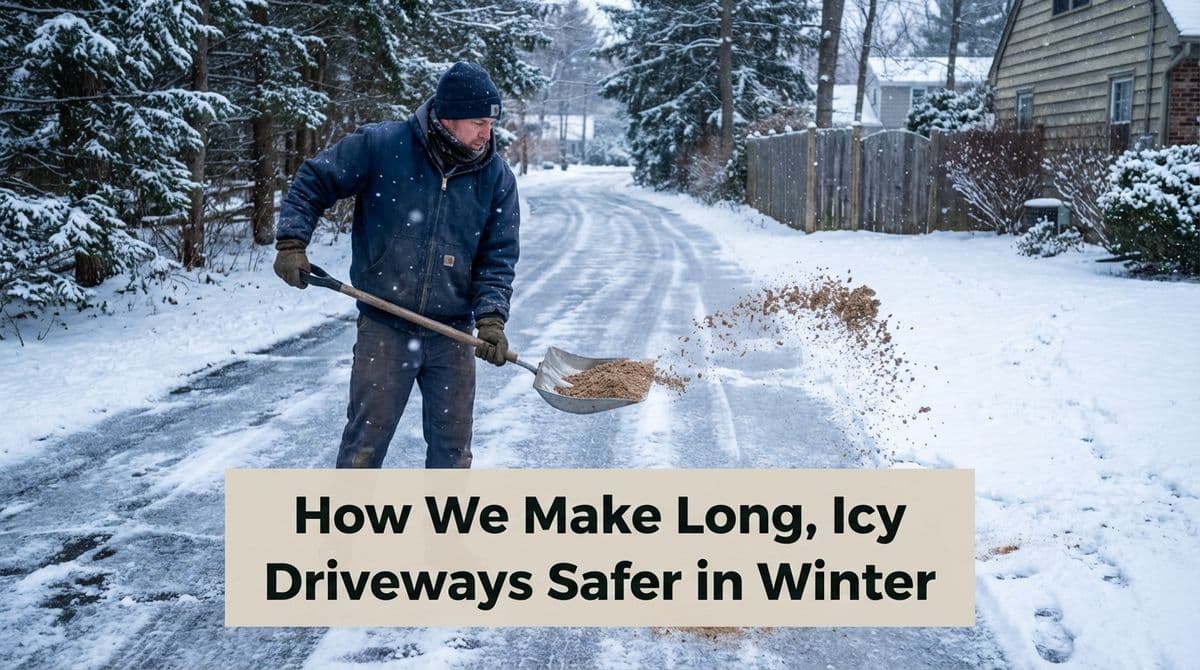
Helping a Neighbor With a Long, Icy Driveway
We recently got a call from a homeowner — let’s call him Mark — who was worried about his long, icy driveway in the middle of a winter warm-up. His driveway is about 800 feet long, but the real problem was the last 400 feet: a steep section with two tight 90-degree turns leading down to a bridge.
The whole thing had glazed over with ice after rain on top of packed snow. Mark normally sands with his own tractor and sander, but for reasons he couldn’t get into, he couldn’t get out there this time. He needed that lower stretch sanded so he and delivery trucks could get in and out safely.
We let him know we could come out as soon as the rain stopped — either later that evening or very early the next morning — and we also reassured him that we’re used to steep, tight, tricky driveways. Mark’s situation is actually pretty common in our winters, so we thought it’d be helpful to walk through how we approach a driveway like his and what you can do to make yours safer.
Why Long, Icy Driveways Are So Dangerous
On a cold, clear day, a steep driveway can feel manageable. Add rain, thawing, and refreezing, and suddenly it’s like driving on a skating rink. A layout like Mark’s — long, steep, and curvy — adds a few specific risks:
- Momentum on the hill: Once you start sliding downhill on ice, it’s hard to stop, especially with 400 feet of slope.
- Two 90-degree turns: Tight corners mean you have to control speed and traction very precisely. On ice, the vehicle wants to keep going straight.
- Limited escape routes: When there’s a bridge, ditch, or drop-off at the bottom, there’s no room for error.
That’s why sanding a driveway like this isn’t just about tossing some material down. It’s about where you put the sand, how much you use, and when you do the work so it actually bonds to the ice.
How We Plan a Steep, Tight Driveway Sanding Job
With Mark, we talked through a simple plan before we ever showed up. If you’re calling someone for driveway sanding — or considering doing it yourself — here’s how we think about it.
1. Decide how much needs to be sanded
Even though Mark’s driveway is 800 feet, he only needed the worst 400 feet done: the steep section and the turns down to the bridge. That’s a smart way to keep costs down while still making things significantly safer.
When you look at your own driveway, focus on:
- Hills and slopes where you gain or lose speed.
- Curves and corners where you have to steer and brake.
- Areas near hazards — ditches, trees, garages, or water crossings.
2. Time the sanding with the weather
When Mark called, it was raining on top of ice — the worst possible driving conditions but a good time to plan. We let him know we’d come out after the rain stopped, either that evening or before 6 a.m. the next morning.
That timing matters. If we sand while it’s still raining hard, the sand can wash off before it has a chance to settle and freeze into the surface. Ideally, we aim for:
- Just after the rain or drizzle stops.
- When temperatures are dropping back below freezing, so the sand locks into the top layer.
How We Actually Sand a Long, Icy Driveway
Once we’re on site, we walk the driveway with the homeowner if possible — just like Mark planned to meet us at the top of his. That way we can see the worst spots and talk through access and turnarounds.
1. Start at the top and work downhill
On a steep driveway, we typically work from the top down. That gives us traction right where a vehicle first starts moving downhill. For Mark’s place, the plan would be:
- Sand the top approach where you first commit to the hill.
- Lay a continuous band of sand down the slope.
- Heavily treat both 90-degree turns, including the entry and exit of each curve.
- Finish by sanding the area before and after the bridge.
2. Focus on wheel paths, not just the center
We aim most of the sand where your tires actually run. On a narrow or winding drive like Mark’s, that often means:
- Two heavier bands in the tire tracks.
- Lighter coverage in the center and at the edges.
- Extra sand on the inside of sharp corners where vehicles tend to cut in.
3. Adjust for tight spots and turnarounds
Mark was worried his driveway might be “too much” for a truck with a sander because of the tight turns and bridge. We let him know we’re used to tight spots — most of our winter calls are just like that.
On tight or awkward driveways we may:
- Use smaller, more maneuverable trucks or equipment.
- Plan specific pull-off or turnaround points in advance.
- Sand in stages if the layout doesn’t allow one continuous pass.
What You Can Do to Make Your Icy Driveway Safer
Even if you’re calling in a pro, there are a few things you can do to make a long, icy driveway safer — and to help the sanding job work better.
1. Mark the edges and hazards
Before a storm or thaw, mark:
- Driveway edges with stakes or reflectors.
- Drop-offs, culverts, and the edges of bridges.
- Any hidden rocks, walls, or landscaping near the drive.
This helps us (and you) stay exactly where we should be when surfaces are slick and visibility is low.
2. Use the right material
For steep, icy driveways, we usually recommend:
- Sand or grit for traction.
- Salt or ice melt only where runoff won’t cause refreezing in dangerous spots.
On a driveway like Mark’s, with a bridge at the bottom, we’re careful about where any melting water will go and whether it could refreeze into black ice later.
3. Drive it like it’s still icy (because it is)
Even after sanding, that long, steep stretch is still ice underneath — the sand just gives your tires something to bite into. We always tell homeowners:
- Use low gear going down and up.
- Keep your speed slow and steady.
- Avoid sudden braking or sharp steering in the corners.
Need Help With a Steep, Icy Driveway?
If your driveway looks a lot like Mark’s — long, steep, curved, and slick — you’re not alone. We spend a big part of winter helping homeowners keep these tricky driveways passable.
Whether you just need the worst 200–400 feet sanded or the whole length treated, we’re happy to talk through options, timing, and cost so you can get in and out safely all winter long.